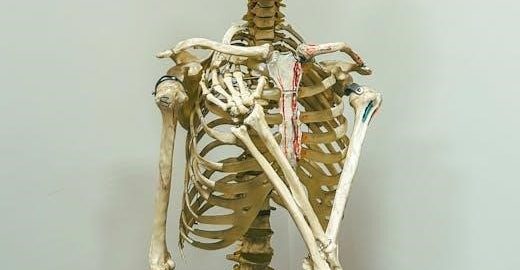
Cells‚ tissues‚ and organs form highly organized systems within the human body‚ enabling a vast range of functions essential for life and overall well-being.
Overview of System Interdependence
The human body’s systems aren’t isolated entities; they exhibit remarkable interdependence‚ functioning as a cohesive unit. For instance‚ the respiratory system provides oxygen crucial for circulatory system’s delivery to tissues‚ while the digestive system furnishes nutrients powering all bodily functions.
The nervous system orchestrates these interactions‚ responding to internal and external stimuli‚ and the renal system maintains fluid balance vital for all systems. Muscular and skeletal systems provide support and movement‚ impacting respiration and circulation. This intricate network ensures survival‚ demonstrating that compromise in one system inevitably affects others‚ highlighting the body’s holistic nature.
The Importance of Studying Human Body Systems
Understanding human body systems is paramount for healthcare professionals‚ enabling accurate diagnoses and effective treatments. Studying these systems provides insights into how life-sustaining processes function‚ from gas exchange to nutrient absorption.
Knowledge of system interdependence is crucial; a problem in one area often signals issues elsewhere. This understanding aids in preventative care and promotes healthier lifestyles. Furthermore‚ exploring these systems fosters appreciation for the body’s complexity and resilience‚ driving advancements in medical research and improving overall human well-being. It’s a foundation for informed health decisions.

The Muscular System
Muscle tissues – skeletal‚ smooth‚ and cardiac – are integral for movement‚ maintaining posture‚ and generating heat‚ supporting numerous bodily functions effectively.
Types of Muscle Tissue (Skeletal‚ Smooth‚ Cardiac)
The human body boasts three distinct muscle tissue types: skeletal‚ smooth‚ and cardiac‚ each uniquely structured and serving specific functions. Skeletal muscle‚ attached to bones via tendons‚ enables voluntary movements like walking and lifting‚ characterized by its striated appearance under a microscope.
Smooth muscle‚ found in the walls of internal organs such as the stomach and blood vessels‚ controls involuntary movements like digestion and blood pressure regulation; it lacks striations. Finally‚ cardiac muscle‚ exclusive to the heart‚ is responsible for pumping blood throughout the body‚ exhibiting both striated features and involuntary control.
These tissues collaborate seamlessly‚ ensuring coordinated bodily functions and maintaining overall physiological balance. Understanding their differences is crucial for comprehending the muscular system’s complexity.
Functions of the Muscular System (Movement‚ Posture‚ Heat Production)
The muscular system performs vital functions beyond simply enabling movement. Movement‚ both voluntary and involuntary‚ is its most recognizable role‚ facilitated by muscle contractions. Maintaining posture‚ even during rest‚ relies heavily on continuous muscle tone‚ preventing us from collapsing.
Crucially‚ muscle contraction generates heat as a byproduct‚ contributing significantly to maintaining a stable core body temperature – a process known as thermogenesis. This heat production is especially important during physical activity or in cold environments.
Furthermore‚ muscles protect internal organs and contribute to facial expressions‚ showcasing the system’s diverse and essential contributions to overall bodily function and survival.

The Skeletal System
Bones provide crucial support‚ protection for vital organs‚ enable movement‚ and serve as a reservoir for essential minerals like calcium.
Bone Structure and Composition
Bone isn’t simply a static‚ solid mass; it’s a dynamic‚ living tissue with a complex hierarchical structure. At its core‚ bone comprises a robust extracellular matrix‚ primarily composed of collagen – providing flexibility – and mineral salts‚ notably calcium phosphate‚ conferring hardness. This matrix supports various bone cells‚ including osteoblasts (building bone)‚ osteocytes (maintaining bone)‚ and osteoclasts (resorbing bone).
Bones exhibit two main types of tissue: compact bone‚ dense and strong‚ forming the outer layer‚ and spongy bone‚ lighter and porous‚ found within. The microscopic structure reveals Haversian systems‚ cylindrical units containing blood vessels and nerves‚ crucial for bone nourishment and repair. Bone marrow‚ residing within the bone cavities‚ produces blood cells. This intricate composition allows bones to withstand significant stress while remaining adaptable and capable of self-renewal.
Functions of the Skeletal System (Support‚ Protection‚ Movement‚ Mineral Storage)
The skeletal system performs several vital functions beyond simply providing a structural framework. It offers robust support for the entire body‚ maintaining posture and bearing weight. Crucially‚ it protects delicate internal organs – the skull shields the brain‚ the rib cage safeguards the heart and lungs‚ and the vertebral column protects the spinal cord.
Furthermore‚ bones act as levers for muscles‚ enabling a wide range of movements. The skeletal system also serves as a critical mineral reservoir‚ primarily storing calcium and phosphorus‚ releasing them into the bloodstream as needed for various physiological processes. Finally‚ bone marrow within bones is responsible for hematopoiesis – the production of blood cells‚ essential for oxygen transport and immune function.

The Respiratory System
Lungs‚ trachea‚ and the diaphragm collaborate to facilitate gas exchange‚ enabling us to breathe and sustain life through oxygen intake and carbon dioxide removal.
Components of the Respiratory System (Lungs‚ Trachea‚ Diaphragm)
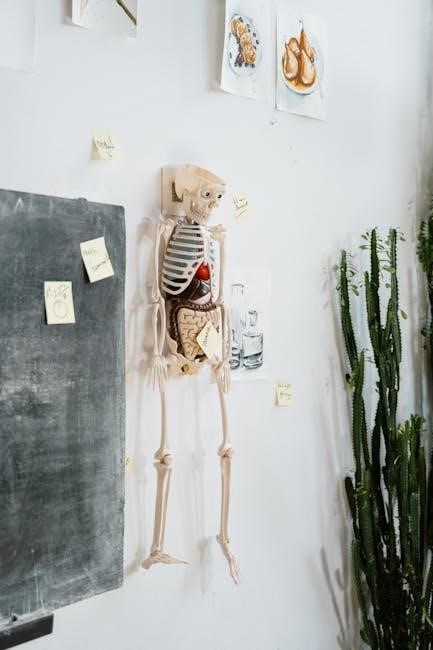
The respiratory system’s core components work in perfect harmony to ensure efficient breathing. Lungs‚ the primary organs‚ are responsible for the crucial gas exchange – taking in oxygen and releasing carbon dioxide. Air travels to the lungs via the trachea‚ often called the windpipe‚ a sturdy tube reinforced with cartilage rings to prevent collapse.
Below the lungs lies the diaphragm‚ a large‚ dome-shaped muscle that plays a vital role in the breathing process. When the diaphragm contracts‚ it flattens and creates more space in the chest cavity‚ drawing air into the lungs. Relaxation of the diaphragm pushes air out. These interconnected structures‚ alongside bronchi and bronchioles‚ facilitate the continuous cycle of respiration‚ essential for sustaining life.
Gas Exchange: How We Breathe
Breathing‚ or ventilation‚ is the initial step‚ moving air into and out of the lungs. However‚ gas exchange is where the magic truly happens. Within the lungs‚ tiny air sacs called alveoli provide a vast surface area for this critical process. Oxygen from inhaled air diffuses across the alveolar walls into the surrounding capillaries‚ entering the bloodstream.
Simultaneously‚ carbon dioxide‚ a waste product of metabolism‚ moves from the blood into the alveoli to be exhaled. This exchange is driven by differences in gas concentration. The circulatory system then transports oxygen to cells throughout the body‚ fueling life-sustaining processes‚ while removing carbon dioxide as waste.

The Circulatory System
A complex network‚ the circulatory system efficiently transports vital substances – oxygen‚ nutrients‚ and hormones – throughout the body‚ sustaining life’s processes.
The Heart and Blood Vessels
The heart‚ a muscular organ‚ functions as the central pump‚ rhythmically contracting to propel blood throughout the expansive network of blood vessels. Arteries carry oxygenated blood away from the heart‚ branching into smaller arterioles and eventually capillaries – the sites of nutrient and waste exchange with tissues.
Veins then return deoxygenated blood back to the heart‚ completing the circulatory loop. This intricate vascular system‚ encompassing pulmonary and systemic circuits‚ ensures every cell receives essential supplies and eliminates metabolic byproducts. Blood vessels’ elasticity and strength are crucial for maintaining blood pressure and efficient circulation‚ supporting overall bodily functions and homeostasis.
Blood Composition and Function
Blood‚ a complex fluid‚ comprises plasma‚ red blood cells‚ white blood cells‚ and platelets‚ each playing a vital role. Plasma‚ the liquid component‚ transports nutrients‚ hormones‚ and waste products. Red blood cells‚ containing hemoglobin‚ carry oxygen from the lungs to tissues‚ while white blood cells defend against infection and disease.
Platelets are essential for blood clotting‚ preventing excessive bleeding. Beyond transport and defense‚ blood regulates body temperature and maintains fluid balance. This dynamic composition ensures the efficient delivery of life-sustaining substances and the removal of harmful toxins‚ supporting overall health and homeostasis within the body’s systems.

The Nervous System
A complex network‚ the nervous system coordinates actions and transmits signals between different body parts‚ ensuring rapid communication and response.
Central and Peripheral Nervous Systems
The nervous system is broadly divided into two main parts: the central nervous system (CNS) and the peripheral nervous system (PNS). The CNS‚ comprised of the brain and spinal cord‚ acts as the control center‚ processing information and initiating responses. It receives sensory input from the body and sends motor commands to muscles and glands.
Conversely‚ the PNS consists of all the nerves that lie outside of the brain and spinal cord. It functions as a communication network‚ connecting the CNS to the limbs and organs. This intricate system relays sensory information to the CNS and carries motor commands from the CNS‚ enabling both conscious and unconscious bodily functions. Together‚ these systems ensure seamless coordination and responsiveness.
Neurons and Synaptic Transmission
The fundamental units of the nervous system are neurons‚ specialized cells designed to transmit information via electrical and chemical signals. Each neuron consists of a cell body‚ dendrites (receiving signals)‚ and an axon (transmitting signals). Communication between neurons doesn’t occur through direct contact; instead‚ it happens at synapses.
Synaptic transmission involves the release of chemical messengers‚ called neurotransmitters‚ from the axon terminal of one neuron. These neurotransmitters cross the synaptic cleft and bind to receptors on the dendrites of the next neuron‚ propagating the signal. This complex process allows for rapid and precise communication throughout the nervous system‚ enabling thought‚ movement‚ and sensation.
The Renal (Urinary) System
Kidneys filter waste and excess fluids from the blood‚ maintaining crucial fluid and electrolyte balance for overall bodily function and homeostasis.
Kidney Function and Waste Removal
The kidneys are remarkably efficient filters‚ constantly working to purify the blood and maintain internal stability. They achieve this through a complex process involving millions of nephrons‚ microscopic structures responsible for removing metabolic waste products like urea‚ creatinine‚ and excess salts.
Blood enters the kidneys‚ where it’s filtered‚ and essential substances – glucose‚ amino acids‚ and water – are reabsorbed back into the bloodstream. The remaining waste forms urine‚ which travels through the ureters to the bladder for storage and eventual elimination.
This waste removal process isn’t just about getting rid of toxins; it’s vital for regulating blood pressure‚ electrolyte balance‚ and red blood cell production. Proper kidney function is therefore absolutely critical for overall health and survival.
Maintaining Fluid and Electrolyte Balance
The renal system plays a pivotal role in meticulously controlling the body’s fluid volume and electrolyte concentrations – a delicate balance essential for cellular function. Kidneys regulate water reabsorption‚ responding to hormonal signals like antidiuretic hormone (ADH) to conserve water when dehydrated or excrete excess fluid when overhydrated.
Electrolytes‚ including sodium‚ potassium‚ calcium‚ and chloride‚ are crucial for nerve impulse transmission‚ muscle contraction‚ and maintaining proper pH levels. The kidneys precisely adjust electrolyte excretion to maintain optimal concentrations in the blood.
Disruptions to this balance can lead to serious health consequences‚ highlighting the kidneys’ indispensable role in homeostasis and overall physiological well-being.

The Digestive System
Organs within the digestive tract work collaboratively to break down food‚ absorb vital nutrients‚ and efficiently eliminate waste products from the body.
Organs of the Digestive Tract
The digestive tract‚ a complex and lengthy pathway‚ begins with the mouth‚ where mechanical and chemical digestion initiate the breakdown of food. The esophagus then transports this partially processed material to the stomach‚ a muscular organ responsible for further breakdown and storage.
Next‚ the partially digested food enters the small intestine‚ the primary site for nutrient absorption‚ aided by the pancreas and liver which contribute crucial digestive enzymes and bile. Undigested material then moves into the large intestine‚ where water is absorbed‚ and waste is compacted.

Finally‚ the rectum stores the remaining waste until it is eliminated from the body through the anus. Each organ plays a vital‚ interconnected role in ensuring efficient digestion and nutrient uptake.
Nutrient Absorption and Waste Elimination
Nutrient absorption primarily occurs within the small intestine’s villi and microvilli‚ maximizing surface area for efficient uptake of carbohydrates‚ proteins‚ fats‚ vitamins‚ and minerals into the bloodstream. These nutrients fuel the body’s functions and support overall health.
Simultaneously‚ the large intestine focuses on waste elimination. Water is reabsorbed‚ solidifying undigested material into feces. Peristaltic contractions propel this waste towards the rectum for temporary storage.
Ultimately‚ waste products‚ including indigestible fibers and metabolic byproducts‚ are expelled from the body through the anus‚ completing the digestive process and maintaining internal balance.